Factoring (called " Factorising " in the UK) is the process of finding the factors: Factoring: Finding what to multiply together to get an expression. It is like "splitting" an expression into a multiplication of simpler expressions. Both 2y and 6 have a common factor of 2: So we can factor the whole expression into:
In mathematics, factorization (or factorisation, see English spelling differences) or factoring consists of writing a number or another mathematical object as a product of several factors, usually smaller or simpler objects of the same kind.
Factorisation is used to simplify complex expressions, solve equations, reduce fractions, and find solutions in algebra. It is essential for topics like Factoring Polynomials and Quadratic Equations. Proper factorisation helps you solve many examination and real-life problems efficiently.
Factoring is a fundamental mathematical technique wherein smaller components—that is, factors—help to simplify numbers or algebraic expressions. This method finds great use in algebra, number theory, practical disciplines like engineering, financial modeling, and cryptography.
This guide discusses what factorization is, different methods of factorization, important factorization formulas, and a step-by-step guide on how to factor expressions.
In math, factorization can be defined as the process of breaking down a number into smaller numbers which when multiplied together arrive at the original number.
Factorization in mathematics refers to the process of expressing a number or an algebraic expression as a product of simpler factors. For example, the factors of 12 are 1, 2, 3, 4, 6, and 12, and we can express 12 as 12 = 1 × 12, 2 × 6, or 4 × 3.
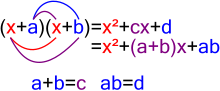 In mathematics, factorization (or factorisation, see English spelling differences) or factoring consists of writing a number or another mathematical object as a product of several factors, usually smaller or simpler objects of the same kind.